It has been said, with considerable justification, that a condition based maintenance policy is of little practical use to a maintenance organization unless it can be automated. Proliferating oceans of condition data have outpaced the limited human resources that can be dedicated to CBM decision making. The solution is to automate CBM – not only the collection of data but also its interpretation. In this article we’ll describe the automation of EXAKT optimal CBM policies.

Using Exercise 1 as an example[1], the failure mode to be monitored is “Trans”.[2] Say the decision model for the Transmission failure mode resides in \Desktop\Example\Cat340T_DMDR.mdb. Therefore, we can create a batch file, say Cat340T.bat that contains commands similar to those shown below.

We can schedule our command file to run, say, the last Saturday of every month, with a Windows instruction similar to:

When the EXAKT decision agent runs, it populates a table in the “_DMDR” database called “Decisions” illustrated below:
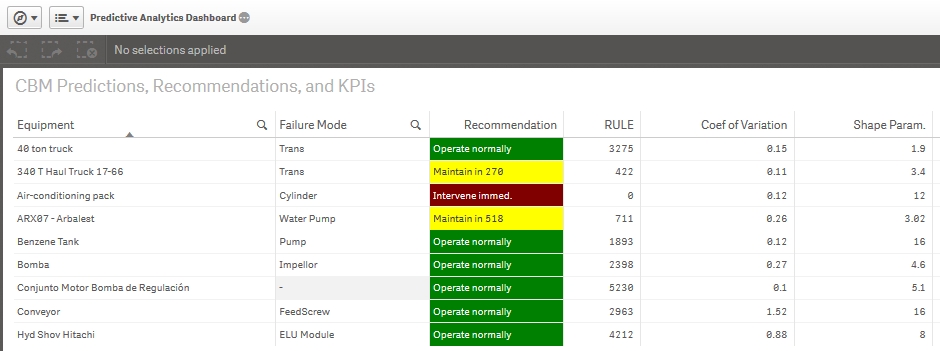
The decisions table is typically viewed using the EAM report generator or in the Mesh cloud deployed Predictive Analytics dashboard below.
Now that we have freed the reliability engineer from the drudgery of having to examine and interpret large quantities of routine CBM data, he can more profitably devote some of his time to Measuring and Improving CBM Effectiveness.
## Post Tree Navigation
LRCM
- CMMS Impediments to Reliability Analysis
- Components of continuous improvement
- How to start LRCM
- Justifying Living RCM Certified
- Leading and lagging performance numbers
- Living RCM Certified – Consulting Services
- LRCM – Reporting failure modes of rotable components
- LRCM and HSE
- LRCM Justification Template
- LRCM reliability analyst survey results
- LRCM reliability technician survey results
- MESH – RCM knowledge continuous improvement
- Motivation, leadership, training
- PAS-55
- RCM – Dashboards
- Reliability engineer’s work cycle
- Service vs. maintenance
- Streamlined RCM and LRCM
- Structured free text
- The role of media in living RCM
- The winning paper at the XIV International Congress of Maintenance
- Two philosophies in maintenance improvement
- Waiting for CMMS maturity
- What is a pilot project?
- What is the difference between RCM and LRCM?
- Achieving Reliability from Data outline with video
- Course brochure – Living RCM Certified
- Deepwater Horizon
- Elevator description of LRCM
- How does LRCM “improve” RCM?
- Living RCM Certified
- Living RCM Certified eLearning
- Living RCM Certified® and ISO 14224
- LRCM – off the maintenance improvement radar
- LRCM-EXAKT – a general solution
- MESH Basic reliability analysis on the work order
- Mesh Living RCM Certified brochure – Mesh Cloud Service
- Obtener confiabilidad a partir de los datos – esquema del curso
- RCM – Analyst course outline
- RCM – feedback suggestion mechanism
- RCM – Living RCM
- RCM – LRCM dashboards
- RCM – feedback – suggesting a new failure mode
- Training course in achieving reliability from data
- Two kinds of decision making in maintenance
- Two LRCM purposes
- Videos
- Why Living RCM works
RCM
Reliability Analysis
- Achieving Reliability from Data
- Challenges to Achieving Reliability from Data
- Data analysis precedes reliability analysis
- Data is the key to the way forward
- Defeating CBM
- Does historical age data have value?
- Failure declaration standards
- Free text on the work order
- How much data is required for RA?
- How to assess EAM and CBM predictive capability
- Interpreting failure data
- LRCM – Reporting failure modes of rotable components
- Maintenance software
- Mesh: 12 steps to achieving reliability from data
- RA requires LRCM
- Reliability analysis in 2 dimensions-Part 2
- Sample selection
- So you’re getting an EAM
- Take the EAM data health check
- The CMMS barrier to RCM
- The data barrier to analysis
- The reliability data Catch 22
- Thoughts from a mine maintenance engineer
- Variations in a sample
- Warranty for haul trucks
- Weibull exercises
- What’s the right data?
- A survey of signal processing and decision technologies for CBM
- Achieving reliability from data
- CBM Defined
- Conditional failure probability, reliability, and failure rate
- Conditional probability of failure
- Conditional probability of failure vs. hazard rate
- Criticality analysis in RCM
- Diagnostics versus prognostics
- Difference between LRCM and EXAKT
- EXAKT’s Three Modules
- Expected failure time for an item whose maintenance policy is time-based
- Failure analysis for reliability analysis
- Failure probability prior to attaining MTTF
- FAQ
- FMEA according to Wikipedia
- Is “random failure” really random?
- Leading and lagging performance numbers
- LRCM and the Failure Finding Interval
- MTTF is the area under the reliability curve
- Myths about RCM in heavy mining equipment
- Non-rejuvenating events
- Optimal PM and spares strategies – exercises
- Performance metrics – Low and High level KPIs
- Problem statement
- Purpose of RA
- RA – Micro (day-to-day decision) analysis
- Random failure and the MTTF
- Random failure is exponential reliability decay
- RCM – Living RCM: Achieving reliability from data
- RCM vs RA
- Real meaning of the six RCM curves
- Reliability analysis is counting
- Reliability trend yes Weibull analysis no
- Remaining Useful Life Estimation Using Hybrid Monte-Carlo Simulation and Proportional Hazard Model
- Safety Instrumented Systems
- TBM or CBM?
- Terminology in LRCM
- Thinking RCM
- Time to failure
- What is PM?
- What is the scale parameter?
CBM
- A survey of signal processing and decision technologies for CBM
- Automating CBM
- Building a CBM decision model
- CBM Exercises
- CBM Optimization
- Combined analysis for early predictive maintenance
- Deploying the CBM model
- EXAKT cost sensitivity analysis
- EXAKT needs LRCM
- EXAKT vs Weibull
- Measuring and Improving CBM Effectiveness
- Optimizing a Condition Based Maintenance Program with Gearbox Tooth Failure
- RCM – Reliability analysis in more than two dimensions is CBM
- Smart CBM demo
- What is Maintenance Decision Automation?
- Confidence in predictive maintenance
- Diagnostics versus prognostics
- Inspections – CBM and others
- Inspections or CBM?
- Internal and external CBM variables
- NAVAIR and the PF interval
- Objectivity in condition based maintenance decisions
- Optimized interpretation of CBM data
- P-F Interval a red herring?
- PF interval from the failure rate
- PM, PdM, Proactive Maintenance
- Predictive analytics
- Temporary fix work orders
- The elusive P-F interval
- [1]In this example the decision model is of a “simple” item. A simple item has only a single failure mode”. Nevertheless the methods described here extend to the general case of “complex” items having more than one failure mode.↩
- [2]Often the object part is all that is needed to specify a failure mode. The full Object part, Object damage, Failure cause syntax is implied to be respectively “Transmission”, “Fails”, due to “n/a”.↩
- What is Maintenance Decision Automation? (89.5%)
- Measuring and Improving CBM Effectiveness (77.3%)
- CBM Exercises (22.7%)
- The elusive P-F interval (22.7%)
- Maintenance Decision Support Pilot at Orica (22.7%)
- Remaining Useful Life Estimation Using Hybrid Monte-Carlo Simulation and Proportional Hazard Model (RANDOM – 22.7%)
Leave a Reply
You must be logged in to post a comment.