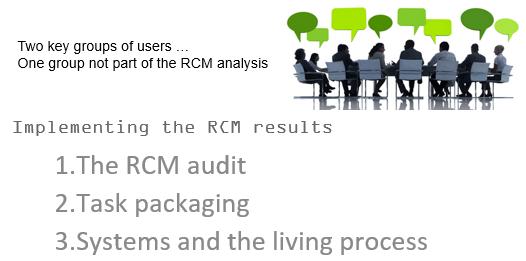
RCM analysis relies in great measure on keen participation by representatives from two key groups: 1) The users (primarily the operators of the physical asset, and 2) the maintainers.
The persons selected to carry out RCM analysis bring years of intimate knowledge of the asset, which they will recall at opportune moments within the process when prompted by the RCM questions. The resulting analysis, therefore, will enact policies that respond to both to the obvious and to the less obvious requirements of maintainers and users.
However, there is a group of asset “users” who do not participate in the RCM analysis and therefore need to be represented. High level managers, shareholders, and society at large are indirect users of the asset and their needs must be considered. That is the auditor’s role.
The RCM audit (slides)
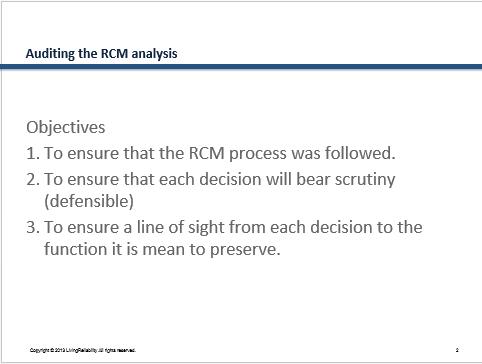
The facilitator makes certain the auditor(s) will have been identified early in process and that they know when they will be called upon to verify the analysis on behalf of the RCM project sponsor (usually an executive or member of the top management team). The auditor’s responsibility is heavy since his are the last pair of eyes to critically examine the decisions to be be implemented on behalf of upper management.
Should a serious HSE event related to the asset occur the auditor realizes that each RCM decision will be subject to close scrutiny by representatives of insurance companies, government regulatory authorities, and the victims or their survivors. The onus will be on the company to ensure that:
- the persons involved in the analysis were qualified, and that
- the decisions were defensible given what was known at the time, and that
- reasonable recurring procedures were in place for timely review and update of the initial RCM decisions.
Choice of auditor
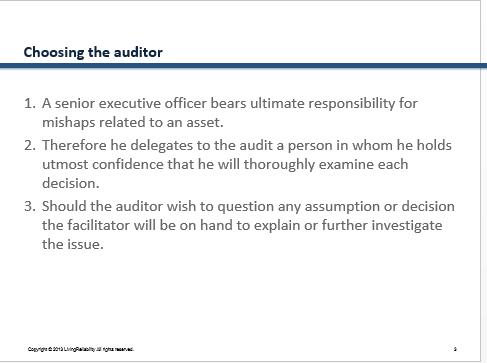
The audit constitutes a vital link in the chain of responsibility leading to the implementation of the RCM results. Once the auditor signs off on the analysis the remaining steps (work packaging, EAM scheduling) may proceed.
A “living” RCM process will kick in as actual failure modes are encountered via the EAM work order process.
Timing of the audit
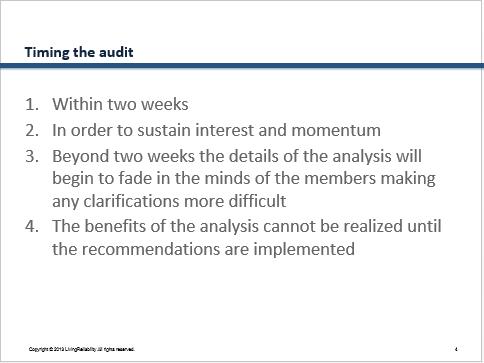 The analysts having expended considerable effort wish to have the results of their labor officially recognized and implemented. Should more than two weeks pass before the audit occurs the analysts’ interest is likely to wane and they may even question the seriousness that management attaches to the entire RCM exercise.
Audit both process and substance
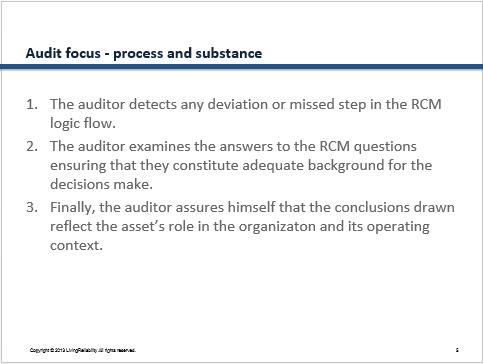
The auditor will have been trained in RCM and will have a good understanding of how decisions are arrived at. The answer to each RCM question builds upon the answer to the previous question. The auditor will follow the logical sequence of decisions. Hence the importance of a readable analysis free from jargon and and consistent within the RCM thought stream. The effects description, as a case in point, should provide all the background and reasoning that would lead to the defensible selection of the RCM consequences. The audit is a sanity check.
Common issues for auditor to watch for:
Functions
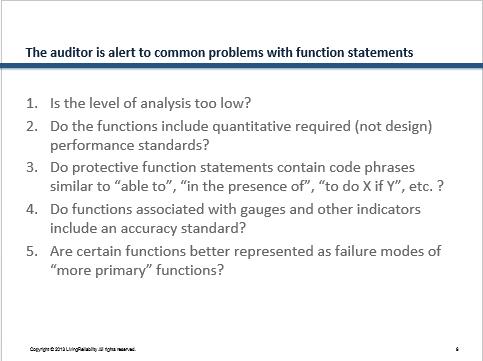
When the analysis has been started at too low a level (for example at too deep a subsystem or component level) telltale symptoms are a large number of items having only a few function statements defined. Such function statements tend to duplicate functions at a higher level but have quantitative standards that are difficult to relate to the overall system’s mission. For example if the engine is being analyzed separately, the function statement containing standards for torque and rpm would duplicate the more primary functions of the truck to transport a specified load along a specified grade and a specified speed. Discussions with the auditor may reveal opportunities to simplify or clarify the analysis. It is often found that RCM can be simplified by analyzing at one level higher than first thought.
Failed states
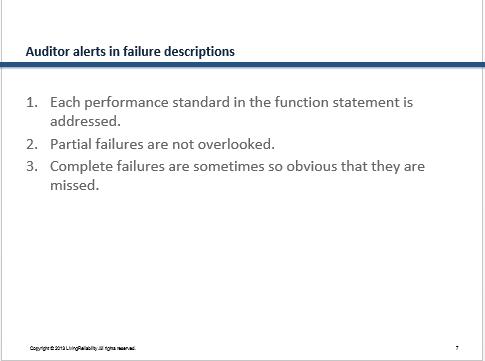
A failure is the the complete or partial non-performance of a performance standard cited in the function statement? The auditor looks out for omissions either of the complete or a partial failure. He may ask, “Have the the complete and partial failures been considered?”
Failure mode issues
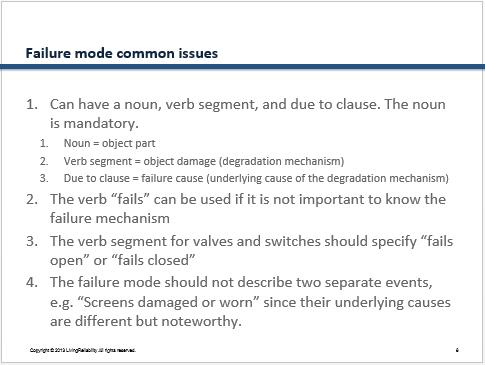
The auditor should be alert to failure mode conceptual errors. Sometimes, the failure modes and effects may have been transposed. For example:
Failure Mode: Fan motor trips out, Failure Effects: Bypass damper jammed wide open.
The above type of error, although obvious here, can easily occur for the reason that an effect at a higher level can indeed be a a cause if the analysis were conducted at a lower level of indenture. If the facilitator does not catch it, this can misdirect the consequences and mitigating task.
Consider the total failure “Does not heat water at all.” A failure mode might be:
- Object part: Immersion heaters
- Object damage: No electrical power
- Failure cause: Power system failure
However if the power system were being analyzed separately, the failure of the immersion heaters would now be an effect of a failure mode within the power system. By including the failure modes of the power system explicitly above as “3. Failure cause: Power system relay trips” within the analysis of the water heating system failure mode segments 1 and 2 remain but the overall analysis is more complete, more concise, and simpler, having avoided a separate power system analysis. As long as the identification of the Power system’s failure modes do not add an inordinate amount of time to the analysis, it is often preferable to include them as part of a comprehensive analysis of the main system, in this case the hot water system.
Failure effects detail
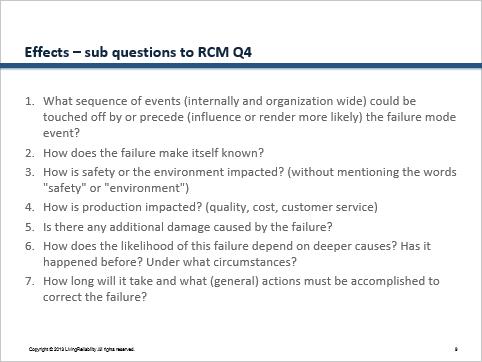
The failure effects touched off by the failure mode justify the final task. Not all the sub-questions to RCM Q4 need be answered. The volume of detail in the effects will reflect the risk (i.e. the severity of the consequences and likelihood of the event) associated with the failure mode.
Consequences attention points
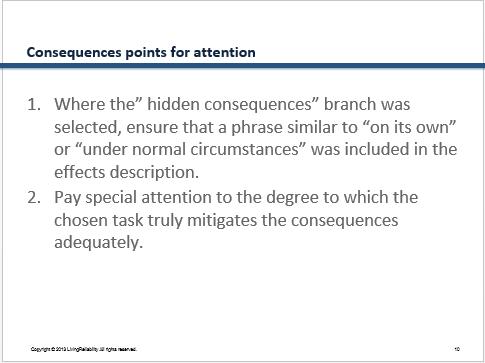
The consequences constitute the raison d’être of the maintenance strategy. Everything that is done will have been directed towards avoiding or mitigating the consequences to a degree that is acceptable by the user. The user can include the owner, the impacted employees, and possibly the community at large.
Task concerns
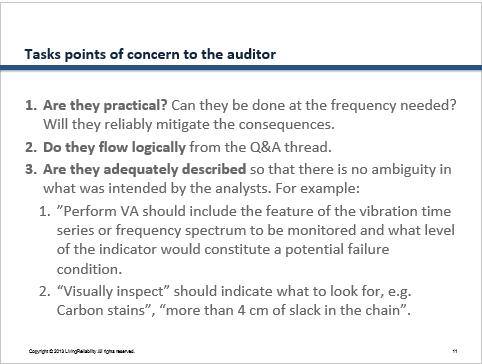
The auditor sanity checks the tasks in the light of the consequences of failure as detailed in the effects narrative.
Clarity and completeness of the task description will avoid ambiguity when the tasks will be transcribed into work packages and scheduled in the EAM’s PM program.
Task concerns
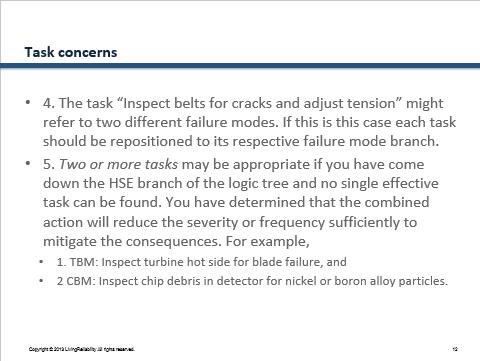
Posing the RCM questions deliberately and completely as written in each node of decision tree will help avoid errors.
The facilitator resists the inclination to abridge the questions. But explicitly asks whether the task will be technically feasible as well as whether it will be effective in reducing the severity and frequency of failure.
Further task concerns – intervals
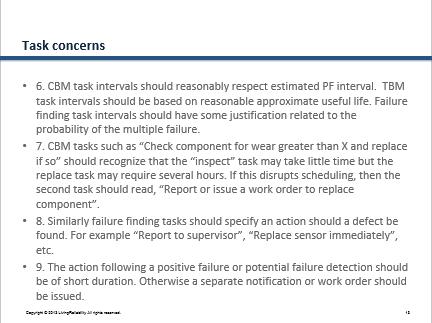
Task intervals are usually judgment calls. The data upon which to base a calculation required in points 6, 7, and 8 will seldom be available to the analysts at the time of the RCM analysis. The analysts may decide to propose a conservative task interval but include in the task provision for gradually acquiring the data necessary for a calculation to confirm or refine the task decision.
Additional task concerns – detailed procedures
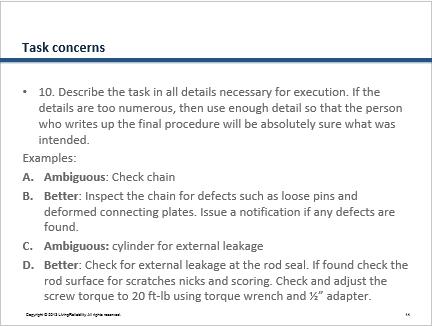
The group members will usually be able to describe the tasks in adequate detail. If not, a simple between meeting assignment would be to formulate the task adequately. This can be done directly by the group member using the MESH feedback system. The facilitator and the rest of the group can then conveniently, using the feedback manager accept the update.
The auditor will sometimes accept the mitigating task contingent on the gathering of further information. For example, he may require that a more frequent information acquisition or inspection task be added to the failure mode task list in order to gain more insight on the reliability of the object part in question. (The reasoning behind this would be detailed in the effects analysis.) The technician assigned the mitigating task would feed back his observations through the feedback system, where they would be processed by the reliability engineer. The RE responsible for the RCM analysis of the subject equipment type.
One-off changes:
Justification
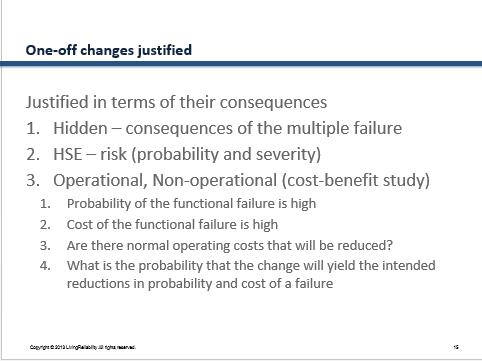
One-off changes include alterations to equipment, processes, or people. When authorizing and implementing changes the auditor bears in mind that change engenders risk. Modifications frequently result in subsequent human error of the intentional or unintentional kind (see Module 3). The facilitator with the help of the auditor will ensure that employees and other managers will be made conscious of the changes and that the required precautions will be included in SOP’s and related training.
Design, implementation, and follow-up
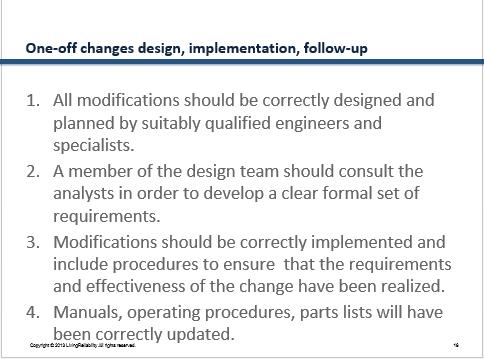
Once audited, the facilitator should ensure that the designer or project engineer fully comprehend the requirements of the modification, and the context, in particular if certain the operating phases will be affected differently by the change.
Managing the one-off change
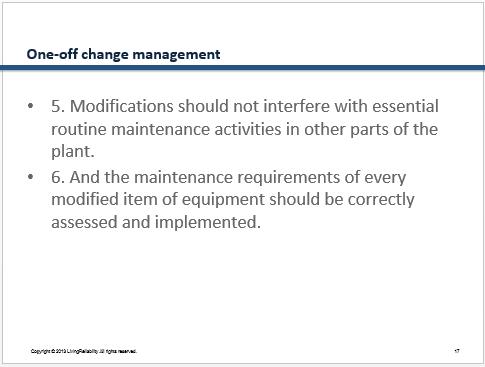
The designer should, based on discussions with the facilitator, ascertain that the modification work schedule accounts for operational schedules and constraints.
The designer should arrange for maintenance and operational changes to be updated according to the new situation.
The RCM auditor’s question tool
In order to maximize the auditor’s effectiveness the Mesh feedback tool may be used to make comments and pose questions to the facilitator. The tool is described in the articles:
and in Slide 21 below.
Packaging the RCM tasks
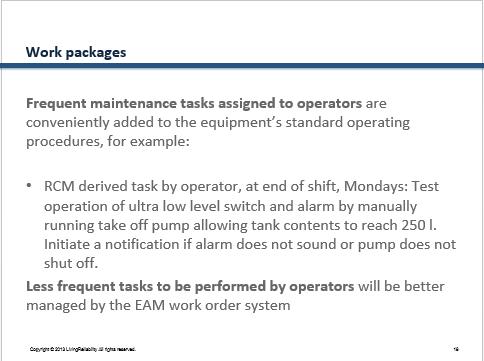
Once the audit is complete, the TBM, CBM, and FF tasks will migrate to EAM system PM schedules or to SOPs in the case of operator assigned tasks
Tasks to be carried out at approximately the same frequencies will be consolidated in recurring PM schedules (attached to PM Work Orders) which list the tasks to be accomplished. A “dashboard” method to select work orders for each package is given in the section: Work Packages.
The work order will be accompanied by supporting documents such as parts lists, drawings, special tool requirements, and relevant safety precautions. Scheduling is simplified if the task intervals are multiples of one another, for example weekly, monthly, 3-monthly, 6-monthly, 12-monthly. As data for reliability analysis is gathered over time, justification for moving a task from a lower to higher interval will be documented in an update to the continuously improving RCM analysis.
Short interval tasks (e.g. daily, weekly) to be performed by an operator will be included more efficiently in the equipment’s operating procedures and any training required will be provided to the operational employees. Longer interval task schedules, even if to be performed by operational personnel, are best handled by the EAM.
Maintenance schedules
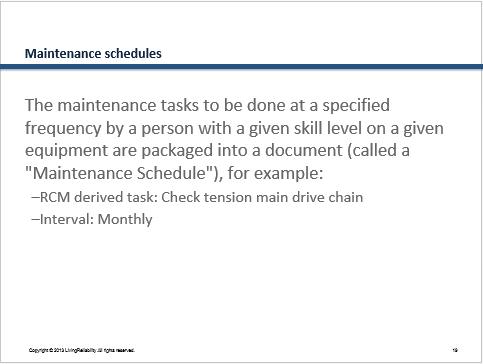
Specific SAP (Maximo, Ellipse, etc.) procedures will be used to configure the PM schedules.
Systems and Living RCM
Planning and control
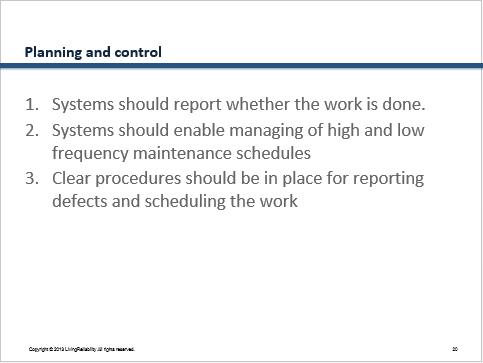
PM schedules and schedule compliance should be monitored properly using the appropriate functions of the EAM system.
Continuous improvement
Analytical grade work order data
Continuous reliability improvement requires two organizational capabilities that most maintenance organizations currently lack:
-
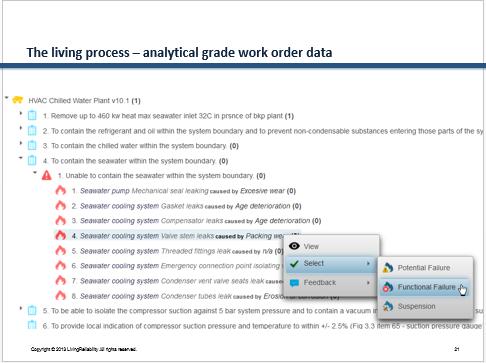
Slide 21 Analytical grade work order data A process to ensure that information transferred into the EAM system from the technician, via the work order, is of analytic quality, and
- Tools for the technician to point out errors or to suggest refinements in the RCM analysis, based on their observations while executing work orders.
The first of these capabilities implies that the EAM catalog values unambiguously capture observed failure mode instances and their life ending events (failure, potential failure, or suspension). This data will allow the reliability analysts to improve TBM, CBM, and FF effectiveness using the reliability analysis and modeling techniques described in module 5 Failure Management Policies.
RCM knowledge continuous refinement
The second “living” capability provides a process for continuous knowledge growth and systematic documentation. A knowledge feedback system providing this capability is discussed in Slides 68 and 69 of the RCM Facilitation module. The initial RCM analysis was performed in the best of faith. It was based on a snapshot and the best recollections and reasoning by a group of competent users, managers, and maintainers. As time passes, knowledge deepens, and physical facts change. The maintenance RCM derived maintenance plan must continue to adapt and align ever closer with reality.
The handover of the RCM analysis to the maintenance department, besides one-time changes, and cyclic task schedules, should also include a process for continuous improvement in the two areas mentioned above.