The facilitator is the individual most responsible for the success or otherwise of the RCM effort. He needs to have acquired a set of specialized skills that we will discuss in the following slides.
Primary function of the facilitator (slides)
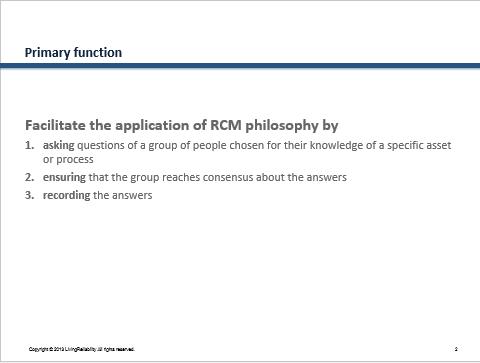
The facilitator guides the analysis sessions with a light but determined hand. He is the RCM process specialist but by no means a specialist in the operation and maintenance of equipment or system under analysis. In those technical matters, the facilitator defers to and elicits knowledge from the operating and maintenance experts assigned to the analysis team.
Secondary functions
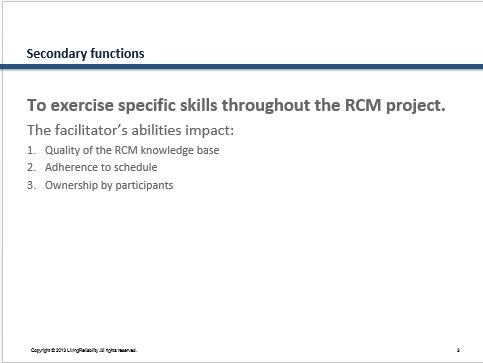
As in RCM itself “secondary” in no way means “less important”. The facilitator’s skill set in management, administration, and human relations will have been honed to meet the huge weight of tasks and responsibilities that fall on his shoulders before, during, and subsequent to the execution of an RCM analysis. The facilitator must exercise his skills in order achieve three key objectives: high quality of the analysis, adherence to schedule, and a strong sense of ownership by the participants whose decisions will determine the maintenance program for the asset.
Required skill sets
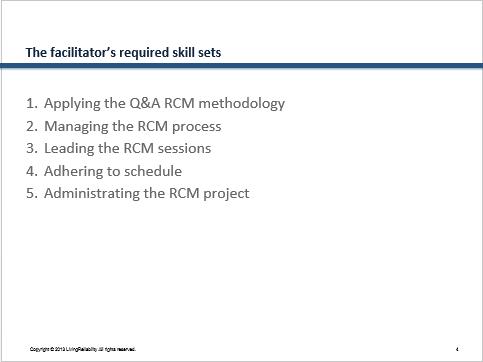
The facilitator leads the analysis exercise by asking the RCM questions according to the method formalized by John Moubray. In the slides that follow we detail each of the five skill sets required to complete all steps beginning with the preparation phase and ultimately to the implementation of the RCM recommendations.
Facilitating the RCM Q&A process
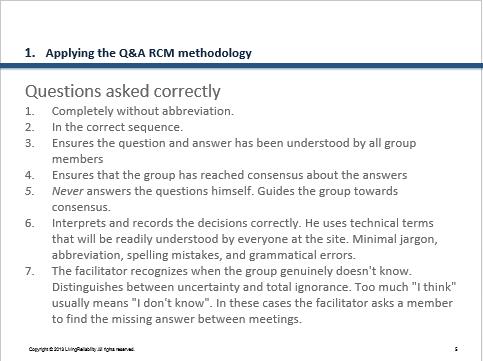
The manner in which the 7 RCM questions and auxiliary sub-questions are posed to the group will influence the depth of thought that the participants apply to the answers. There are a good number of traps that can diminish the quality of the answers or divert the team from accomplishing their mission. The facilitator must be aware of the potential problems and remains alert to the their telltale signs.
Q1 The function statement
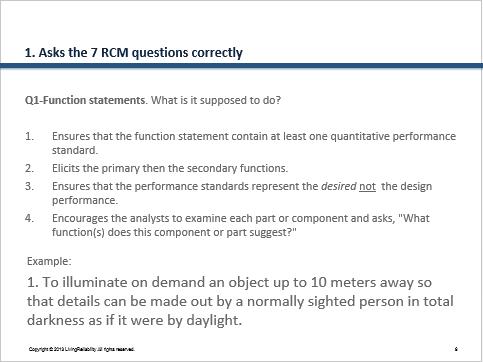
We should begin listing functions at the higher (indenture) level.
If the higher level analysis is getting too large and unwieldy [1] for the team to complete in a reasonable time frame we can “break out” a sub-system or component.
Slides 23-27 discuss the subject of level of analysis.
Q2 The failed states address performance requirements
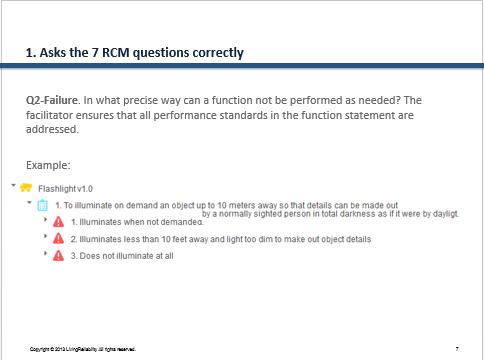
If the function statements are well constructed the failure descriptions will be obvious and concise.
The facilitator takes care to fully raise the complete and partial failure possibilities. The complete failure will often expose the non-hidden failure (unwanted functioning) of a protective device. Including such events as failure modes of a total failure simplifies the overall analysis by avoiding the negative functions in the functional analysis, e.g. “Not to shut down feed pump when level is below 200000 l ”
Q3 – The failure mode
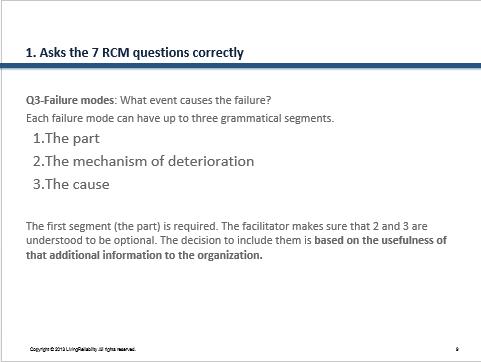
In many instances only the “part” segment of the failure mode sentence needs to be identified. For example, if the part is an inexpensive throwaway and the frequency of the failure is not excessive, and there are no HSE consequences it would be counterproductive to force the analysts to seek out information about the actual failure mechanism or underlying cause.
In these instances the failure mode “Printed circuit board fails” may suffice. There may be no benefit to determining which component on the PCB was defective. One should also bear in mind that the RCM knowledge base of failure modes will be embodied in the catalog values (Object part, Object damage, and Failure cause) displayed to technicians in drop down lists. Excessive detail in the analysis will translate to repetitive unnecessary complexity when completing the work order form.
There is another reason why the failure of a complex component may have its failure mode described simply as “Turbocharger Fails” or “Transmission Fails” or “Engine Fails”, etc. It is because the technician simply swaps out the defective module or subsystem. If it is a rotable component to be repaired on site, the actual failure mode would selected be on a “child” work order of the the original work order. Often the component is sent to a contractor or vendor facility for repair. In those cases cause detail may serve no economic purpose. Rotable components are discussed in the commentary attached to Slide 27.
Q3 Which failure modes to include
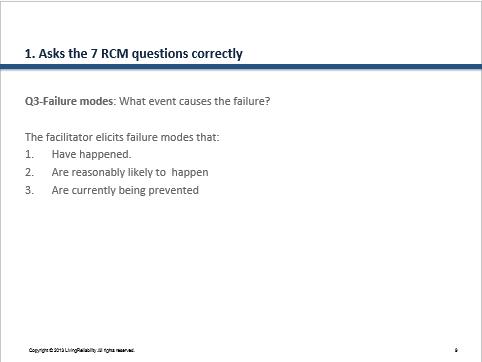
No set rules or criteria specify which failure modes are too unlikely or whose consequences are not severe enough that the failure mode should be excluded from the analysis. As an example the failure mode “Pump damaged by falling airplane” might be included, should it be operating inside a nuclear installation whose safety integrity depended on that pump and its location were along the trajectory of a busy flight corridor.
Q3 The failure mode due to clause
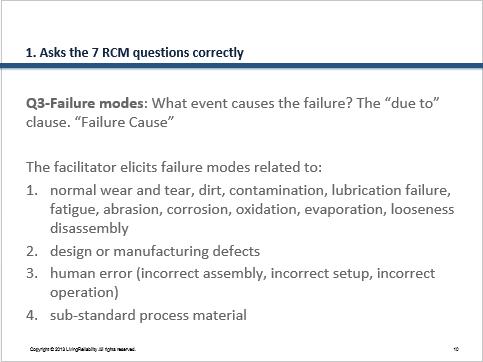
As already discussed (Slide 8) it is not always necessary nor advisable to include a variety of failure mechanisms and underlying causes when the effort is not justified by the likelihood and severity of the failure consequences.
If a switch fails open, it is not necessarily of added benefit to the analysis or to the subsequent reporting of instances of that failure mode in the EAM to expend the added time to differentiate whether the failure was due to rust, corrosion, or dirt. The facilitator makes the decision of how deep in the causality chain to go based on the comments of the operators, technicians, and other experts in the RCM analysis group. Is the additional information worth manipulating? The facilitator may ask whether the failure mode occurs frequently and is of consequence “Do we really want to know, in this case, why exactly the switch fails open?”. Will “Switch Fails open” suffice as the failure mode description in this instance?
Similarly, it is not advisable to state explicitly that the failure cause was “human error” when the object damage (failure mechanism) was “valve left open”, or “motor incorrectly wired” suffices to describe the failure mode completely. RCM is sensitive analysis. Why rub salt in the wound?
Q3 Failure mode depth and quantity
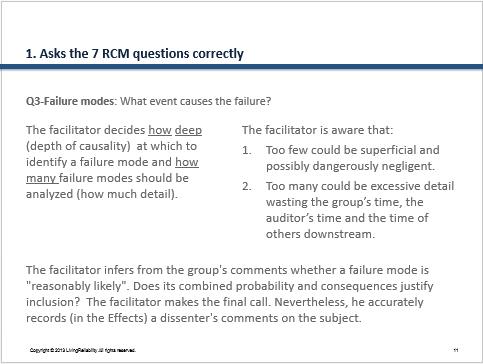
This slide drives home the point that the facilitator’s role is one based on judgment and balance. The term “reasonably likely” reflects both the consequences of failure and the frequency of failure. If someone insists that a failure mode should be included against the judgment of the group or that greater depth is required, the dissenting viewpoint should be noted in the Effects description of a related included failure mode, or the failure mode may be included with the Effects stating that its “occurrence is considered unlikely”.
Q4 Failure Effects – the story
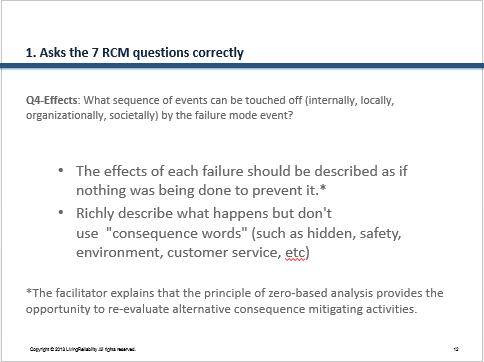
From our cave dwelling days man has been telling stories. We are wired to convey important principles, thoughts, and ideas via the narrative of events. We humans respond to a story because it captures our attention and sets the creative wheels turning. The effects description is the place to let our minds’ eyes soar and develop hypothetical scenarios of event sequences that could reasonably occur when touched off by a failure mode event. The facilitator encourages this group conjecture process until the point where it has exhausted the reasonably likely possibilities. As the severity of the the consequences increases, more improbable effects may be explored. Time, of course, is the constraint ever present in the facilitator’s mind.
Q4 Failure effects – the sub questions
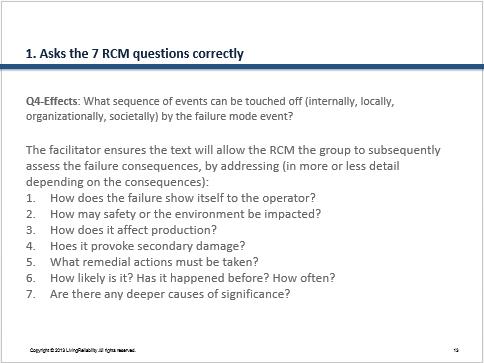
The facilitator uses the effects description’s sub questions to prompt discussion towards the goal of having all the information needed to choose the appropriate consequences branch of the decision tree. The effects description can also provide clues towards choosing a practical and effective mitigating task.
Q5 – Why does it matter – the consequences of failure
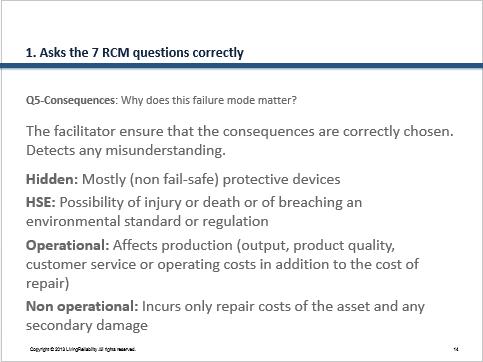
While the first four RCM questions are interesting in their own right, they lay the foundation for the ultimate reason for choosing one maintenance task over another. Why does the failure matter? Why should the user be concerned as to the effects and likelihood of the failure mode event occurring?
Nowlan and Heap were the first to articulate the seemingly obvious observation that we are concerned ultimately and primarily with the consequences of failure. The failure itself or its cause were of interest only insofar as they affected the consequences. This revelation profoundly impacted commercial aviation and, more broadly, modern maintenance strategy.
Q6 – The PM tasks – what can be done proactively?
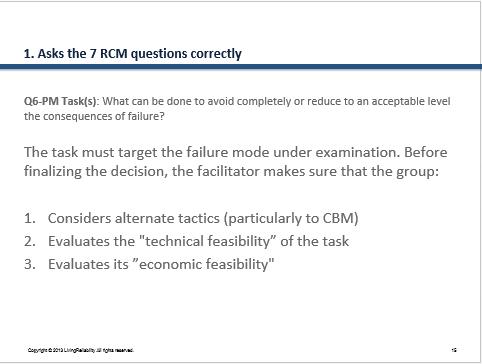
The facilitator assures himself that the analysts are confident in the selected task’s likelihood of accomplishing the objective – to reduce the risk (severity of consequences and frequency) to a tolerable level.
A sense of seriousness pervades the entire analysis and particularly the choice of mitigation activity, given that the group itself has taken on a weighty responsibility.
Q6 – The PM task intervals
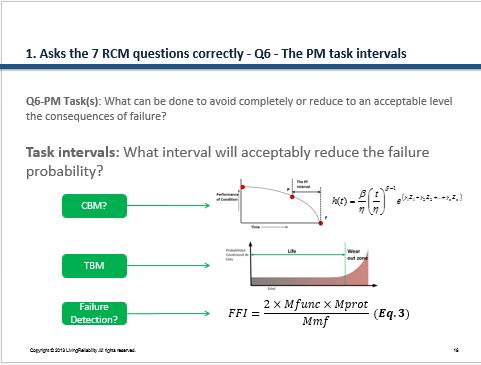
Often the data needed to perform the task interval calculation will be unavailable. This is particularly the case for CBM where a specific condition indicator and / or its value at the Potential Failure state are uncertain or unknown. Yet the analysts believe that CBM is appropriate. However more data would be required before the task can be considered technically feasible.
A combination of two or more tasks (TBM and CBM) with conservative task intervals proportionate to the severity of the consequences and frequency of failure should be implemented with the goal of collecting the additional data needed for building a verified CBM decision model. [2]As data accumulates predictive models can be developed by estimating the parameters of the proportional hazard relationship:

where β>0 is the shape parameter, η>0 is the scale parameter, and γ =( γ1,γ2,… γm,) is the coefficient vector for the condition monitoring variable (covariate) vector Z(t).
The parameters β, η, and γ, will need to be estimated in the numerical solution using a RA software application such as EXAKT. CBM performance indicators, such as the standard deviation σ around the conditional mean life, which is also known as the remaining useful life estimate (RULE), and the value of the shape parameter β may be used to measure the confidence in CBM predictive capability. [3]
Q6 – Correctly describing the PM tasks
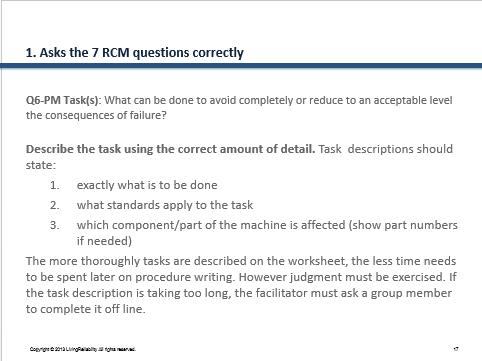
Describe the task such that there will be no possible ambiguity when it is transcribed to the EAM input form to be issued as a cyclic PM standard work order.
Additional details can be verified if necessary as a between meeting assignment to one of the members.
Q6 – Task selection by correctly navigating the decision tree
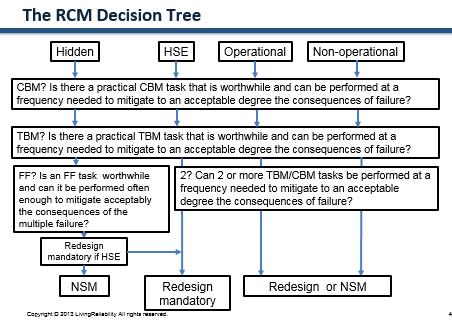
Although tedious and repetitious, the facilitator nevertheless enunciates the questions relating to a task’s applicability and effectiveness in each node as the team descends the correctly selected branch of the decision tree.
Q7 – Goals of the redesign default option
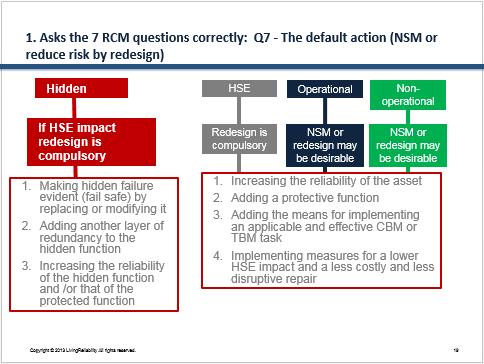
In the version of the RCM decision tree used in this course, if no proactive tasks are found applicable and effective, we drop through to the default options: 1. Redesign, or 2. No Scheduled Maintenance (NSM).[4]
NSM is self explanatory. However the goals of redesign depend of which branch of the decision tree culminated in the redesign option. The slide offers a memory aid for the team when describing a require modification.
Managing the RCM process
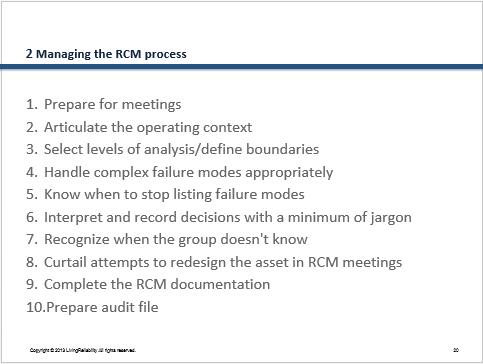
The RCM process management skill includes activities conducted both inside and outside the RCM sessions. Additionally, the facilitator is responsible for preparing for the RCM analysis as well as preparing for the audit as well as assisting the auditor.
Prepare for the meetings
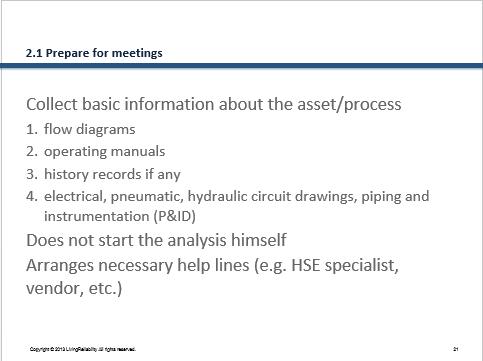
Collaborating with the one or two of the designated analysts prior to the first session, the facilitator ensures that the necessary reference materials are on hand in the RCM session room.
It is likely that a vendor, safety specialist or process specialist will be called upon during a session. The facilitator sets up the communication channel and notifies the relevant parties that they may receive a call requesting information or a clarification on some point that may arise during the group’s deliberations.
Articulate the operational context
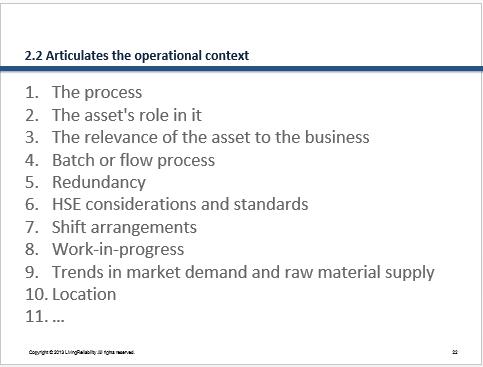
The operating context should describe the operation of the asset and can include or reference drawings and flow diagrams. The equipment’s role in the overall process should be described so that the analysts will be aware of the impact of failure on the organizational mission. This information will influence the answers to the RCM Questions 4 Effects, and 5 Consequences.
The different operating phases of the asset will be pointed out in the description of the operating context because some functions are unique to a particular phase of operation. Redundancies both internally and externally are relevant and should be included. Built in test equipment (BITE) should be listed. Important previous incidences or concerns relating to HSE should be noted as well.
Levels of analysis and boundaries
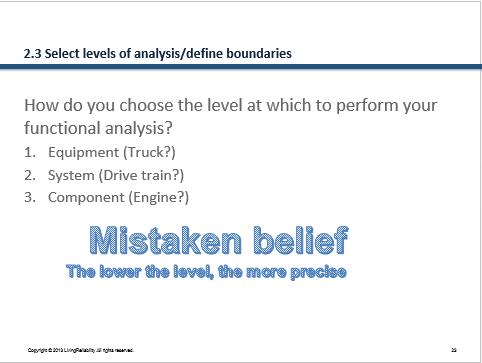
The level of analysis is the node in the asset’s work breakdown structure below which you identify functions. This sets the staging area for developing the remainder of the analysis. In the Functions module we discussed the use of RCM software and the advantages of starting the analysis, i.e. listing functions, at a reasonably high level. When it becomes apparent that the higher level analysis is getting too large [5] for the team to complete in a reasonable time frame we may easily “break out” a sub-system or complex component, as discussed in Slide 27 below.
The advantages of starting high
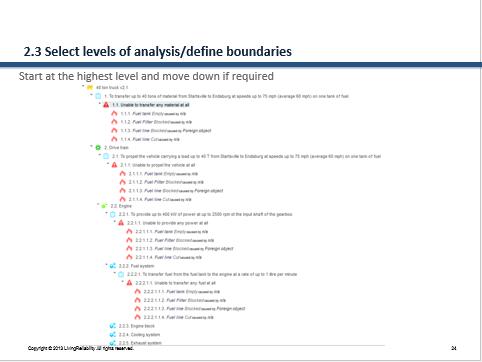
This slide shows the RCM analysis starting to listing functions alternatively at 4 different levels of indenture. We can see that the function statements and their failed state descriptions at higher levels are essentially reincarnated at lower levels but with different performance standards. Yet despite the increase in complexity and size of the analysis we note that starting at lower levels has added no more precision to the identification and analysis of the relevant failure modes.
Other disadvantages of starting too low
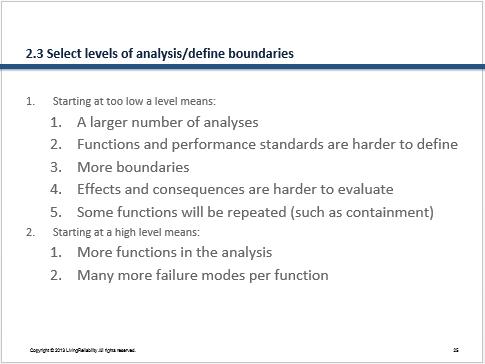 By starting at as high level as is reasonable, the facilitator will minimize the time and complexity of analysis. The quality of the analysis should generally improve since the function statements are more likely to be well documented with well understood quantitative performance standards. There will be fewer function statements overall than if subsystems are analyzed separately.
Start high then move lower if necessary
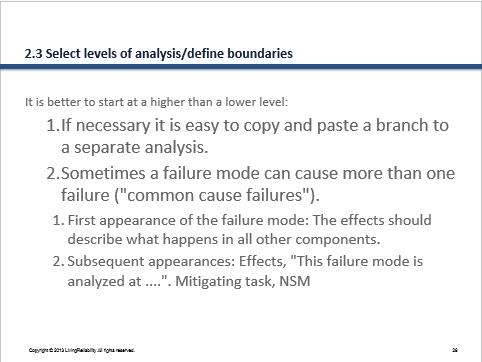
Once the analysis is complete there may be reasons for separating out certain complex components. For example a corporate work breakdown structure may have been previously established in the EAM and it is desired that the analysis conform to the corporate standard. Alternatively it may be desirable to separate a rotable component out into its own branch of the RCM tree. The RCM software makes it a simple matter to separate out complex components without having to reanalyze them.
Complex components
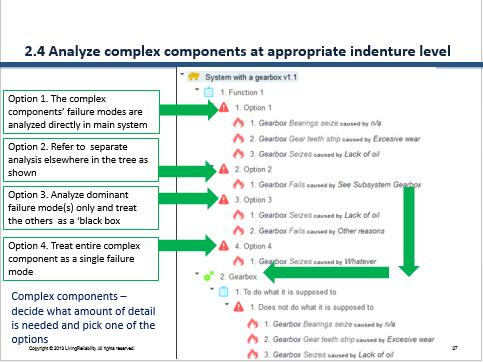
In the discussion of Failure Modes we learned to identify Failure Modes at a level of causality which best allows us to identify a suitable failure management policy. This reasoning carries over to the way to deal with complex sub-systems encountered in the item we are analyzing.
RCM does not advocate any particular level at which to perform the analysis. Assume we have a system that contains a pump set. If it’s a standby and there are no dominant failure modes which stand out we might state the failure mode simply as “Pump set fails” and proceed to the Effects, Consequences and mitigating activity (probably a regular check to determine it is still operational). If however it is known that there is a chronic organizational habit of “borrowing” parts from the standby equipment we might add a due to clause “due to missing parts”. The mitigating activity might be to increase the spares inventory, or require that a work order be issued immediately to replace the borrowed part.
“Rotable” components
There is another reason one might wish to “break out” a component to its own branch in the RCM hierarchy tree. This reason concerns “rotable” components. A rotable component is one that is routinely removed from a parent, overhauled in the shop or by a third party, returned to storage, and eventually re-installed on another (or on the same) parent. They are maintainable serialized components whose working ages are “traced” by the EAM.
During the EAM setup traced components will have been configured to have their individual operational hours tracked as if they had their own physical hour meters. As hours are clocked on the parent the rotable component’s virtual hour meters advance by the same amount. Failure modes (parts) of the rotable component that are not renewed during the overhaul retain their age, while those that have been renewed (as documented on the rebuild work order) will be zero-timed by the RA software. Since the EAM tracks the component’s working age as it migrates from location to location the (age and condition based) failure behavior of individual failure modes (parts) in that component can have their instances counted and analyzed.
For purposes of reliability analysis performed on the failure modes of a rotable component, it may be convenient for the rotable component to occupy its own branch on the RCM/EAM asset structure tree.
Which failure modes to exclude
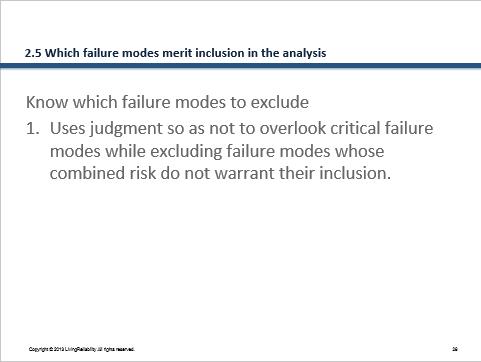
The number of failure modes can be infinite, or at least very large. At some point the facilitator has to decide that a failure mode’s combined probability and severity of its consequences are low enough to justify its exclusion from the RCM analysis. As usual the group consensus the facilitator’s final decision.
Minimum jargon and simplified structure
The analysis must be easily readable, jargon free, and as simple and compact as possible yet still be precise and detailed enough to defend (and continually improve) the maintenance plan.
A good quality analysis minimizes the number of Function statements. The Function statements can be reduced by embedding some functions implicitly as failure modes of the more direct primary and secondary functions of the asset. In our example, the chevron component provides primary isolation from bumps. However this function is more simply included by including two failure modes, “Chevron rubber settles” and “Chevron rubber elastically yields” under the function: “To provide smooth rolling support for half the weight of a passenger car (up to 26.5 tons) on the rails at speeds up to 120 kph“. In this manner we end up with a smaller analysis having fewer Function statements, but without sacrificing needed detail. This refactoring of certain functions as failure modes rather than explicitly expressing them in function statements, is one of the ways the facilitator simplifies (with the agreement of the group) the RCM analysis.
Recognize absence of sufficient knowledge
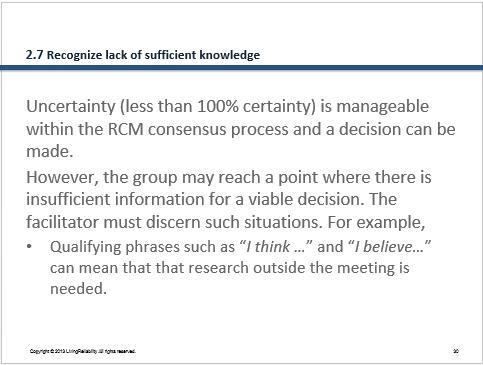
It may sometimes become apparent that the group does not have the knowledge or experience to make a particular decision. Phrases such as “I think” and “I believe” dominate the discussion. At such times the facilitator might request that a member of the team confirm the facts and report them at a subsequent meeting (or provide a suggestion through the software’s feedback system).
Avoid redesign in the meeting
Being technical people and natural problem solvers, there is an almost overpowering desire to redesign the asset or operating procedures inside the meeting. It is imperative that the facilitator rein in the redesign brainstorming impulse by limiting the discussion to a clear specification of the requirement or goal and one or two obvious ideas. The analysts will have the chance to elaborate their ideas on the subject, once the analysis will have been audited and the recommendations implemented.
Complete the RCM knowledge base
When editing the analysis outside of the eeting, the facilitator’s focus is on clarity but he must not change the wording to the extent that it becomes unrecognizable to the analysts.
The advantage of network based software is that all the members can access the analysis between meetings and propose their own additions. The facilitator at the beginning of a session points out any significant changes he may have made on his own to make sure that he has not altered the intent of the analysts.
Prepare the audit file
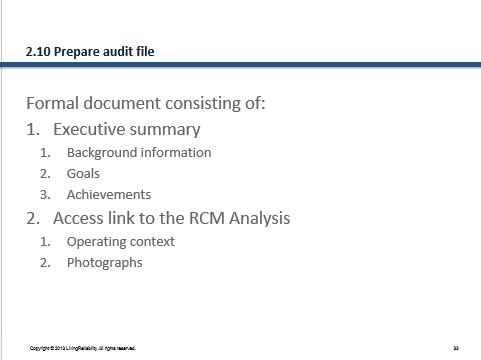
The facilitator prepares a formal document consisting of everything the auditor needs to assess and approve the analysis. The document should reference, by function, failure, and failure mode number (e.g. 12.3.1), specific areas of the analysis that might be of particular interest to the auditor.
Lead the RCM sessions
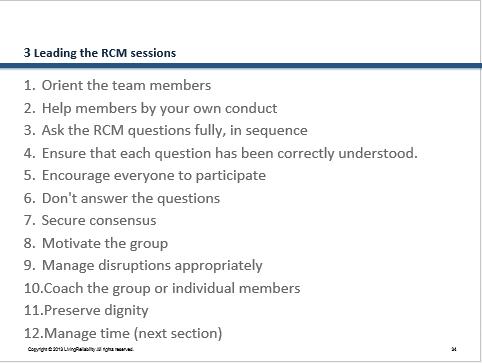
The facilitator should display a positive attitude. He should arrive early, greet the participants, and thank them at the end of each session. He should be receptive to body language signals (raised eyebrows, folded arms) during the session that may indicate dissatisfaction with how the process is going or disagreement on a certain point of discussion. “You seem to be in disagreement, Tom, with this decision. Would you like to add something here?”
It is important that the facilitator sustain full participation of the team members while recording all group consensus decisions.
Two group members may have had some past altercation or disagreement. If some hostility is evident in the discussion the facilitator must make it clear why we are here and why we are tackling this project as a group. No personal clashes or inhibitions should interfere with the free flow of ideas. In the worst case the facilitator may have to call upon the assistance of the sponsor to diplomatically reassign an obstreperous member “Jack, I need your help with the budget.”
Orient the team members
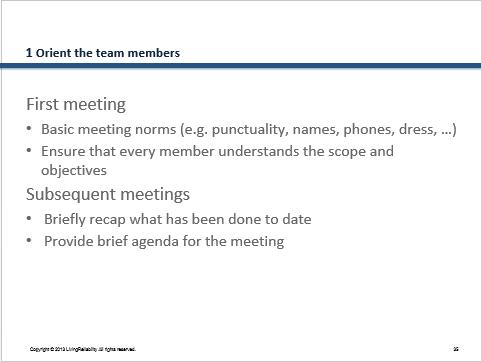
It is important to set the ground rules at the first meeting. Remind the members that they have been chosen for their knowledge and experience. But no one has all the information. The purpose of the group dynamic is to illicit a variety of perspectives and recollection relating to each failure mode under the microscope.
A summary at the beginning of each meeting will maintain continuity and and the flow of thoughts from one meeting to the next.
Exhibit exemplary conduct
Any complaints by the leader or negative sentiments about the difficulties and inconveniences associated with session attendance will quickly infect the group.
The facilitator should make it a point to provide positive feedback at the beginning, during, and at the close of each meeting.
Adhere to question sequence
Tedium in the repetitive nature nature of the process should be creatively dealt with. The facilitator modulates his voice when posing the questions and exhibits interest and curiosity in the answer.
Referring to the RCM worksheet guide will help avoid abridging the questions to the extent that their intent is lost. What does a component do in a particular mission phase? How might the function of a component be refactored as a failure mode elsewhere in the RCM hierarchy?
Ascertain questions understood
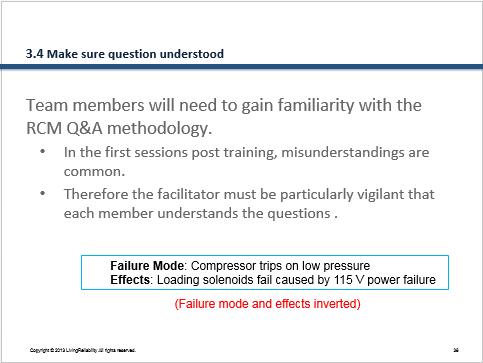
During the ramp up period, while posing the RCM questions, the facilitator should repeat certain points that emphasize the nature of the RCM process. For example, “We are trying to include all the failure modes that may reasonably occur.” “We are trying to arrive at a defensible maintenance plan that is economical.” “Our decisions are rational and justifiable given our knowledge of the asset.” “Even as a group, there will be times that we recognize gaps in our collective knowledge.” “We are trying to get at the right amount of detail so as not to spend too much time if it is not necessary. We need to balance the amount of detail with the likely consequences and likelihood of this failure mode occurring.”
Alert to common confusions
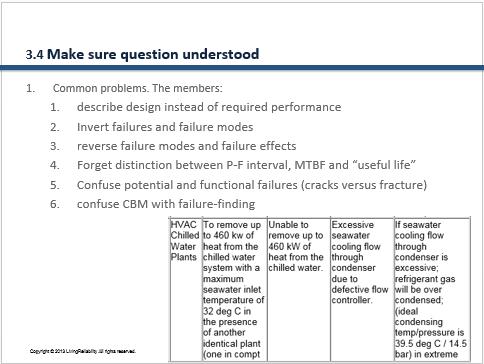
Due to the huge variation in failure scenarios, effects, and consequences mistakes in identifying the appropriate RCM concept can easily arise. This can send the analysis off on a time consuming tangent. When this happens, the group, with the help of the facilitator, who keeps asking and rephrasing the RCM questions, regains the process.
Encourage participation
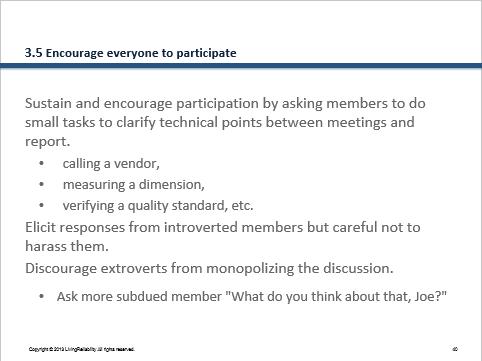
The speed and quality of the analysis depends entirely on the group’s full participation. Initially everyone will be curious. But their enthusiasm will slacken should the meetings bog down or go astray. Keeping focused on the objective – a practical, logically consistent, and defensible maintenance plan will sustain interest. Ownership, in RCM, means that the team feels responsible for defending the decisions taken. They are acting in their own interest but also on behalf of their fellow employees, the company, and the highest level of management who are ultimately responsible if something goes terribly wrong.
Don’t answer the questions
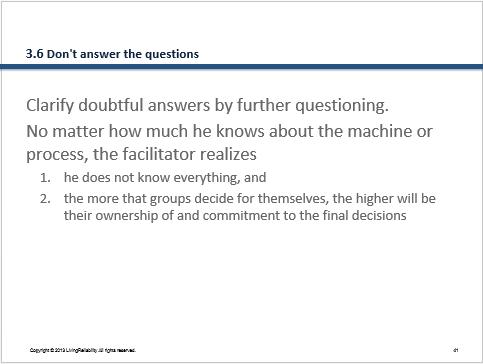
Use the RCM process to pose questions that will evoke the members’ insight, knowledge, and experience. Keep the RCM guide handy and refer to it often and as needed kick start the discussion. If the facilitator thinks that the response is incorrect or incomplete, he rephrases the question. “What happens in the situation …?”
Gain consensus
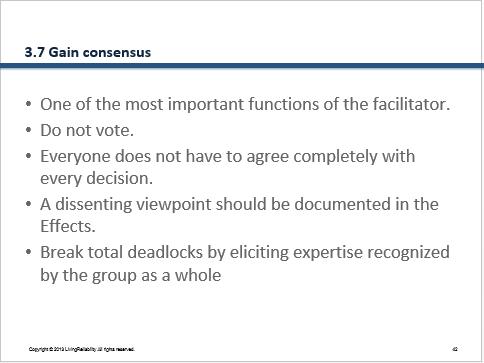
When there is some doubt in the answers, the facilitator should ask what is unsatisfactory in the decision. A differing perspective by a group member can uncover a failure mode or effect that will contribute to the quality of the analysis.
Motivate the group
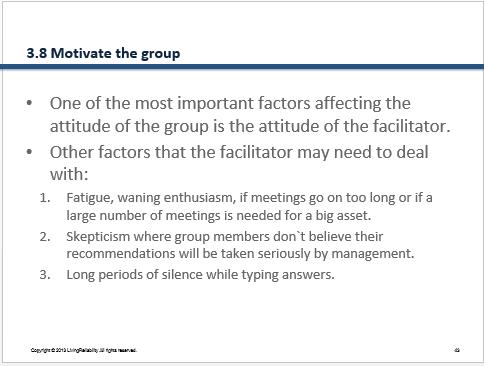
Typing and word smithing might take place when developing the effects description. Word smithing can be an interactive exercise. Grammar, spelling, and punctuation should be polished up off line as long as the meaning is clear and reflects the group consensus. Use a second browser window to recycle similar text from a previously composed effects description. Using the “Append from” feature copies a complete “leaf” (failure mode, its effects, consequences, mitigating task, interval, and images) for reuse and editing in the current leaf.
Positive feedback – it’s always nice to receive a thank you. At end of
meeting, say goodbye and thank you. They should come happy and leave happy.
Manage disruptions
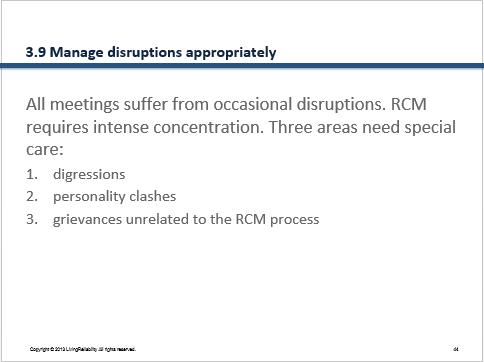
Anecdote: There was a macho neanderthal clique consisting of the union rep with his sidekick who were assigned to the RCM review group. The rep felt that the boss didn’t ask for his participation politely. At the first meeting sitting next to his assistant, he pulled out a newspaper. During member introductions the facilitator got a noise which sounded like a name. He sensed hostile vibes. He start easing
away. He tended to hide behind flip chart.
Trick #1 – don’t physically back away, start moving forward. Trick #2 – handle hostile digressions within the RCM process. This is extraordinarily effective. Example: An hourly paid fitter asks “What about the lockers in the changing rooms?” That is a hostile digression. He says that the hasps are broken and that he’s been moaning about this since forever. The facilitator might ask what stopped him from taking his drill and fixing it himself? That would be a mistake. An unnecessary aggression.
Instead, the facilitator proceeds as follows. “That’s an interesting one. Now what’s the function of the lockers? Therefore the functional failure would be what? Unable to .. Failure mode – hasps broken. Failure effect: People can get in and muck around in my pornography.” (You’re not laughing – that’s important – keep a straight face, critical to be absolutely deadpan.) After the laughter has died down, eventually you say, “Now let’s proceed in the same way with the [physical asset that we have been asked to analyze]”
Another anecdote: We were talking safety consequences and management cooperation. The conversation goes like this. “What about the cockroaches under the paper mill. (It’s wet there.) What’s RCM going to do about that?” “OK let’s have a look. What’s the function? Not to upset well being of employee with unsavory insects. Functional failure: Well being upset. Failure mode: cockroach falls down shirt. Failure effects: cockroach may be carrying diseases, employee may reel back and bang his head. Is there a warning? – visible cockroaches. Mitigating task: Call exterminator on detection or schedule restoration of insecticide treatment at 1 yr when we know the poison is wearing off. We’ll definitely put this idea forward as a pilot project Thanks very much.” Someone says, “Don’t you touch that cockroach, he’s the one who carries my toolbox.”
Trick #3 is a last resort. Involve senior management. Very rarely you get the odd really extreme case. Some guy who wrote his thesis on some reliability subject was out of control. He became a hell of a handful questioning everything. He was managed by his subordinate who took the problem to his boss. The problem member bit his tongue for the rest of the course. Eventually he became one of the strongest RCM proponents.
Trick #4: Dealing with previous baggage brought to the meeting. Someone, in response to another member’s response shouts out “That’s bullshit.” The facilitator must ask immediately. If there is any ancient personal history confront it directly and agree that within the meeting we will be focused on the asset. Our challenge is a high quality defensible maintenance plan
Coach
The facilitator will have ensured that all group members have been on an the introductory RCM course.
If the group as a whole starts getting confused about the RCM process, the facilitator calls a time-out to clarify the point. He switches temporarily from question poser to teacher mode.
If only one or two individuals seem unsure of process, coach them outside the meetings.
Preserve dignity
It’s so easy to slip here. At the first meeting when setting the scene and establishing the ground rules, say “Let’s all agree to refrain from editorials (except about the asset). Everyone is wrong sometime. We’re here as a group precisely in order to filter out any mistaken beliefs about the asset.” Let’s go back to school. Remember those teachers that we didn’t like. 2×2=5? who ridiculed you? What didn’t you study? What has she done to this kid? She destroyed him.” Back to our own situation – we may have a guy, possibly a supervisor or superintendent, that is feeling very comfortable in this project. His dignity is up and he’s volunteering lots of information. Suddenly people start realizing that this guy didn’t know so much. That may start putting cracks in his self image. Now you have to be very careful. At first he talked a lot. He will quiet down. Then he might get hostile, skip meetings, and may cause a lot of damage to the whole process. What can you do with this guy? Tell his boss to diplomatically say that the individual is too valuable, he’s needed to help him on the budget, and that he cannot spare him to the RCM project.
RCM knowledge is a composite
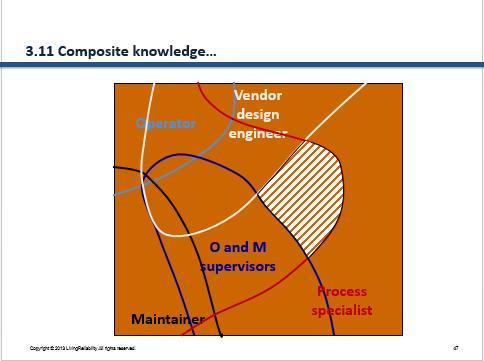
The animated Venne diagram illustrates the need for collaborative knowledge. Who must be involved? The maintainer doesn’t know it all. The supervisors have knowledge some of which overlaps that of the technicians. The engineers, designers, vendors and the process specialist each have their areas of expertise. Lots of commonality. Subtle elements obvious to some may be revelations to others. The facilitator explains that this is entirely to be expected.
There are other resources. Technical history records are sometimes useful, but often of little help since the failure codes on work orders have been inconsistently applied, imprecise, or too specific. They have not been set up with anything like the care and precision of RCM. The P&IDs. Wiring diagrams, flow diagrams are required. Note the gap in the middle of the diagram. If you elicit knowledge from a group consisting of these people, you will have 80-95% of the information needed to complete the analysis. You will have some black holes. Is this a weakness? No it’s a strength. You know that there are areas where you don’t know. A reminder of the advantages of humility, constant curiosity and for a continuous, living RCM knowledge refinement process.
Group effort
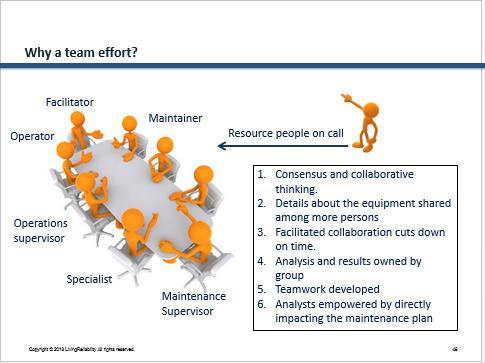
RCM, besides generating a defensible maintenance plan is a learning experience for everyone. Since the group is multi disciplinary the individual perspectives on the asset are shared. An appreciation of the needs, constraints and capabilities of the roles other than your own enriches you and the organization. It was mentioned in the introduction that it is not unusual for chronic problems to be solved early on in the process, especially during the functional analysis. While an operator explains a certain routine, the electrician might point out a mistaken premise about what happens. The reverse can happen when the technician turns out to not fully understand the operator’s requirements.
Adhering to schedule
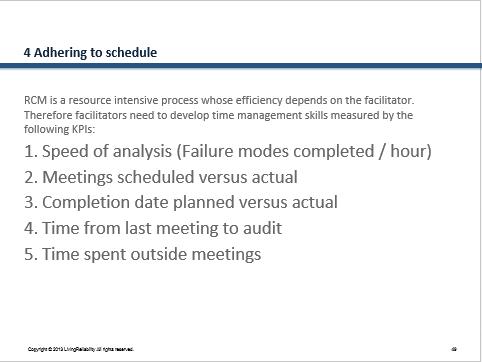
Time performance is measured by the % compliance with the scheduled number of meetings, the scheduled completion date, the time between completion and audit (should be less than 2 weeks). Another performance indicator would be the time spent by the facilitator outside of the meetings.
Speed of the analysis
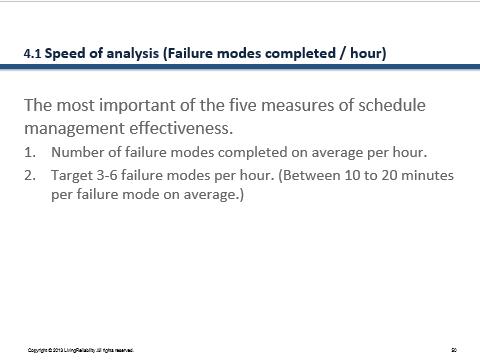
The target is 6 failure modes per hour averaged over the entire analysis. An asset having 120 failure modes should be analyzed in 5-6 4 hour meetings. If an analysis was scheduled to require 12 meetings the functional analysis should be complete by the end of meeting 4.
Number of meetings scheduled versus actual
Target: Within 20% of estimate.
Analysis completion date
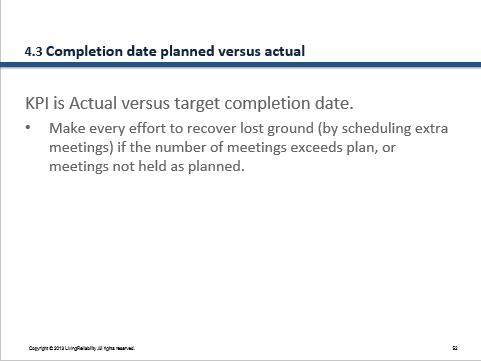
Target: Should be completed by due date. If time was lost for any reason, the facilitator should schedule extra meetings in order to catch up.
It is even conceivable that the facilitator cuts out part of the analysis, say a complex component, in order to finish by the due date.
Time to audit
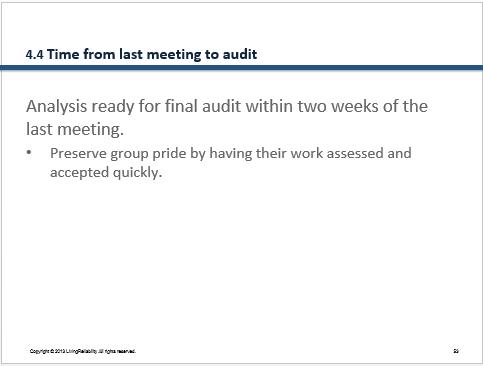
The facilitator should remind and warn the auditor of an upcoming audit at least a week preferably 2 weeks in advance. The facilitator should make himself available to assist the auditor(s) by filling in some of the rationale if needed behind the decisions, and by explaining any RCM principles that the auditor may be less familiar with.
Time outside meetings
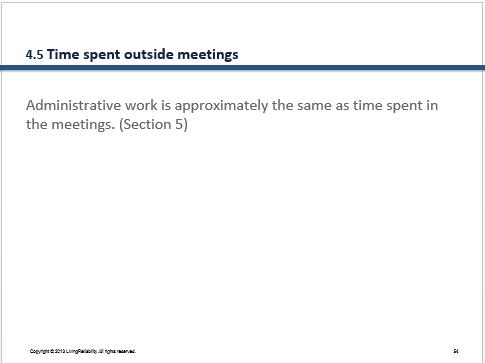
This implies that if meetings are held 8 hours per day 5 days per week, the facilitator will be putting in a lot of extra time outside normal working hours. This is likely to slow down the rate of failure mode analysis and could affect quality of the analysis.
Administrating the RCM project
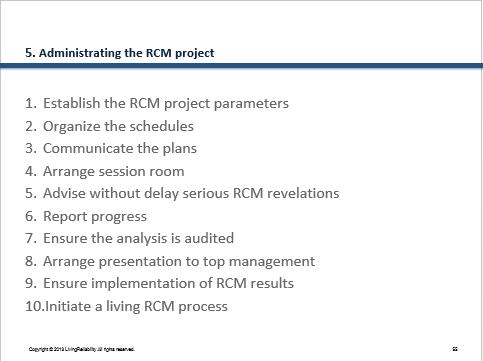
This skill set covers ways in which the facilitator interacts with people
who are not usually members of review groups. Activities include arranging the logistics and all of the bureaucratic and reporting requirements of the analysis.
Project parameters
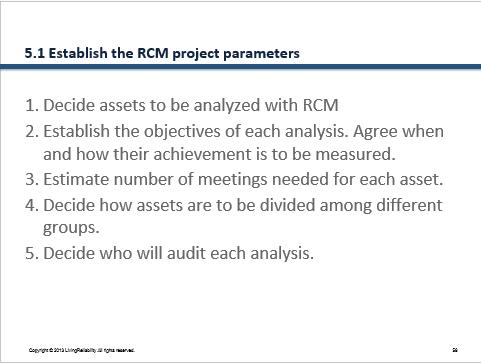
The project parameters define the overall scope, objectives, and resources needed.
The schedules and plan
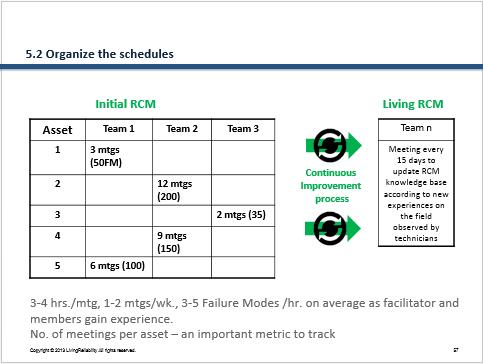
This is RCM’s most important metric: The number of 4 hour meetings per system or component analyzed. Subdivide the plant or facility targeted for RCM. Decide which assets are to be analyzed, in what order, and by whom. Estimate the no. of meetings 6, 9, etc, for each item to be analyzed. We recommend 1-3 half day meetings per week.
Organize the schedules
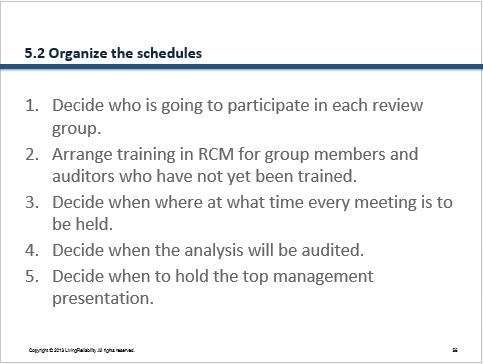
The schedules should take into account contingencies such as sickness, vacations, operational constraints.
The schedules are the way to manage expectations and keep upper management comfortable about the progress of the entire RCM effort.
Communicate the plan
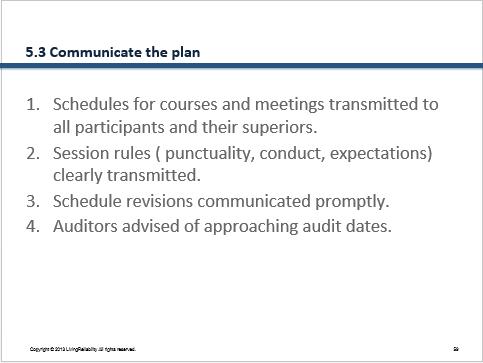
A simple flow chart indicating the paths of communication among the analysts, facilitator, auditor, sponsor, and additional resource people will help keep the project on track.
Session room
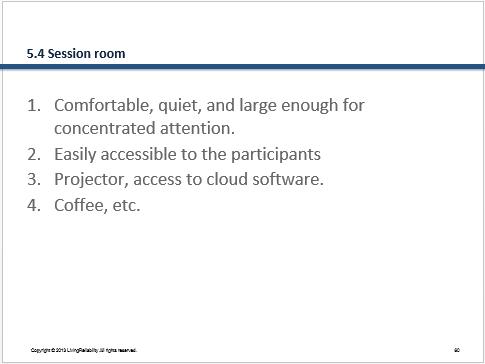
A high degree of mental concentration is required. The room should be relatively free from distractions.
Quick reporting where appropriate
In addition to regular progress reporting (next slide) revelations of immediate import should be transmitted to the interested people. These might include opportunities as well as imminent dangers thought to be highly probable.
Report progress
It will be helpful to set up a standard form or template for such reports. For example:
- Analysis title: Equipment x
- Number of meetings scheduled.
- Number of meetings held:
- Number of failure modes estimated:
- Number of failure modes completed:
- Estimated date of completion:
- Estimated date of audit:
Ensure analysis is audited
The auditor(s) may find it particularly useful to use the software’s feedback system to pose their questions, or articulate their doubts concerning a particular decision. This will make it easy for the facilitator and the entire group to follow the discussion and respond as needed.
Top management presentation
Prepare and deliver a 20 – 30 minute formal presentation for top management preferably delivered by one of the
hourly paid team members.
- 9-10 slides
- showing key parts of the analysis
- Who was in review group?
- Analysis took us 120 man-hours
- Started on __ finished on __
- Total cost __
- What was achieved $1.2 M/an
Ensure implementation
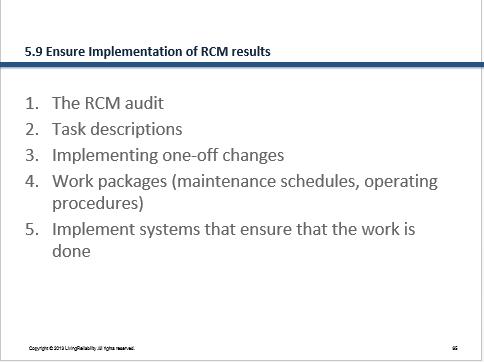
The facilitator as the key enabler of the analysis needs to stay involved following the audit. He ensures that plans are underway for completing the task descriptions, implementing the one-off changes, creating the work packages and ascertaining the procedures by which for the scheduled tasks are to be accomplished and measured (% compliance).
Initiate a living RCM process
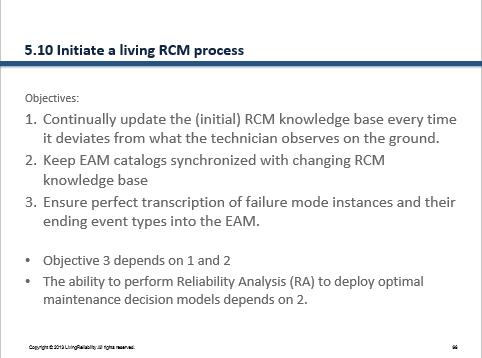
Once the analysis recommendations have been implemented, the analysis should not be abandoned.[6] Rather it should be kept visible day-to day among the maintenance technicians, planners, and engineers. It should be updated whenever, during the execution of a work order, the technician’s observations and the RCM knowledge base divert. In other words the substantial investment in RCM training and culture should be exploited indefinitely. The RCM way of thinking should become a key enabler of effective communication in the entire Asset Management sphere.
Initiate living RCM – technician
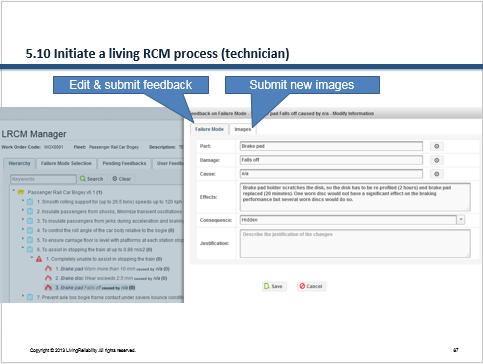
There should be a mechanism whereby technicians may conveniently recommend such RCM knowledge updates.
One such technique displays the RCM tree view with the work order form to be completed upon execution of the work. Supervisors, planners, engineers, or technicians should easily propose changes to the RCM analysis and even submit sketches or photographs. A formal method of review (next slide) should be set up.
Initiate a living RCM process – facilitator / reliability engineer
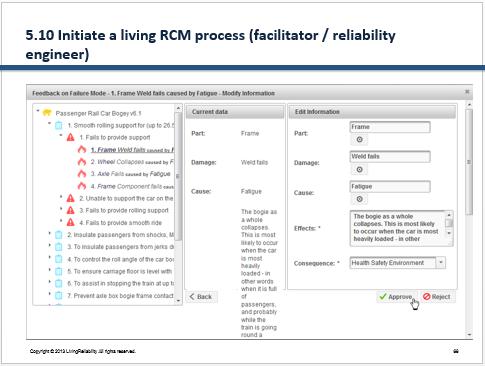
The proposed changes are reviewed by a reliability engineer charged with maintaining the currency and accuracy of the RCM knowledge base. Once approved, the analysis is updated.
To supplement the continuous review process the group may reconvene formally every 9 to 12 months to formally review the analysis. Key questions:
– Has the operating context changed?
– Has the asset been modified?
– Have any functions/performance standards changed?
– Have any unanticipated failure modes occurred?
– Do any failure effect descriptions need changing?
– Should any failure consequences be reassessed?
– Are all tasks still technically feasible and worth doing?
– Do any task frequencies need to be changed?
– Should we consider any new preventive techniques?
– Should any tasks be done by someone else?
Who is going to be the facilitator?
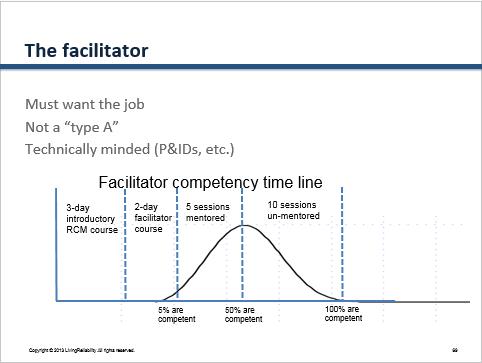
Note that it is strongly stressed that the facilitator be an employee of the company that operates the asset. Not an outside consultant. Anyone who has a long term vested interest in the success of the analysis. This could be a long term contractor. Bacon and eggs. The chicken was involved but the pig was committed. It does not have to be an engineer but the facilitator must have a strong technical background. At least a strong technician or tradesmen. A lab technician was one of the most successful. We do not want a driving personality. Persistent yes, tenacious, yes. A consensus builder. He has to have sufficient stature for the rest of the group to find credible.
The facilitator is highly receptive to people, their unconscious mannerisms and gestures. He needs to elicit the unstated and sometimes unconscious knowledge within even the introverts on the team. Mike is a bit of a loner. He’s happy there. Doesn’t get a kick out of human contact. Will seat himself as far away from the facilitator as possible. The facilitator, having scanned the body language around the room, notices Mike’s eyebrows go up. Asks him his opinion –
“You happy with this Mike?” “Yeah I suppose so.” “You sound like you would like to add something.” “Yeah it doesn’t go up it goes down.”
On the other end of the spectrum one team member shoots off interminably eventually – he might wind down. At that point ask someone else their opinion. The maintenance superintendent, for example, might be monopolizing the meeting. In extreme cases, if he cannot be discouraged, the facilitator will go to the boss. The boss, preferably before the maintenance superintendent loses stature due to having been shown to be wrong too many times, says “Fred I need you too much. Help me with the audits”.
Example: Induction hardening of crankshaft journals. Five axes of rotation. Alternating the direction while work piece going up and down with the chain and rotating. It wasn’t working terribly well. Operator, Wally Innocent. 6’6″ mid fifties, a giant, quiet, most mild mannered men usually are, like a cloud, about as threatening as the wallpaper. He was treated as such. The group completely ignored him. A very extroverted electro-mechanical device guy was a rising young star. He totally ignored Wally. Until the RCM session, when Wally would suddenly come out with: “It’s not you know, what you guys are talking about …,”. The electro-mechanical tech says, condescendingly, “What we are asking Wally ..” . Wally keeps contradicting “it didn’t you know”, “it doesn’t you know”. Gradually the dynamics change, until everyone starts checking with Wally: “doesn’t it Wally?” “didn’t we Wally?” Guess what happens to Wally – vertical rise in the group. They all realized that he knew more about the machine than anyone else on earth. Chinese group: Very hierarchical separation between managers and workers. The facilitator uses a highly Socratic method. Asked what’s the objective of maintenance for this item. Not a word, but they knew. We’ve forgotten to do something. To consider reverence for age and seniority. Combination old + senior. “Face” is very important. The senior man wanted to give his subs the opportunity to say something. The subs, on the other hand, were deferring to the sup. When the culture is highly hierarchical the most senior man in the room must say “guys I’m not going to answer these questions, I want you to speak out”.
- [1]more than 40-60 functions or more than 80-120 failure modes↩
- [2]The process of gathering data for the purpose of refining the TBM and CBM plans is known as “age exploration”. A simple way of gathering this information is provided by living RCM whereby each instance of a failure mode is recorded along with its ending event type Failure, Potential Failure, or Suspension. Eventually a sufficiently large data sample will be available for determining the TBM or CBM policy.↩
- [3]High β (> 4) and of σ could indicate misreporting on the work order of suspensions as failures or inconsistent choice of failure modes.↩
- [4]Other versions, for example NAVAIR 00-25-403 require that all task options be considered simultaneously and the most appropriate one(s) chosen.↩
- [5]more than 40-60 functions or more than 80-120 failure modes↩
- [6]In the author’s experience, few RCM analyses are revisited and updated systematically or at all↩